Time of writing: 01/26/26
(1847 words)
Note: this article is broken up into sections that have been constructed in a linear fashion for those who do not want to limit their exposure to the details of the book and the movie. Thus, the introduction reads like an abstract, giving the reader enough information to then decide whether they should proceed to invest their time in the works discussed. The next two sections focus on what makes both renditions special and how they best support each other. If you plan on going into the movie and book with little to no information, I recommend stopping after the second section of the article. And finally, the third section covers the book in detail. Here, the four main themes of the book are examined while both mediums are discussed, compared, and contrasted.
Introduction and Abstract:
At the time of writing this article, the movie Hamnet, its staff and performers, have all been winning awards and garnering the attention it deserves. One of the questions I received recently was whether it was advisable to read the book before the movie. Conventionally, people believe that this is the right way to experience a title with multiple adaptations across multiple mediums.
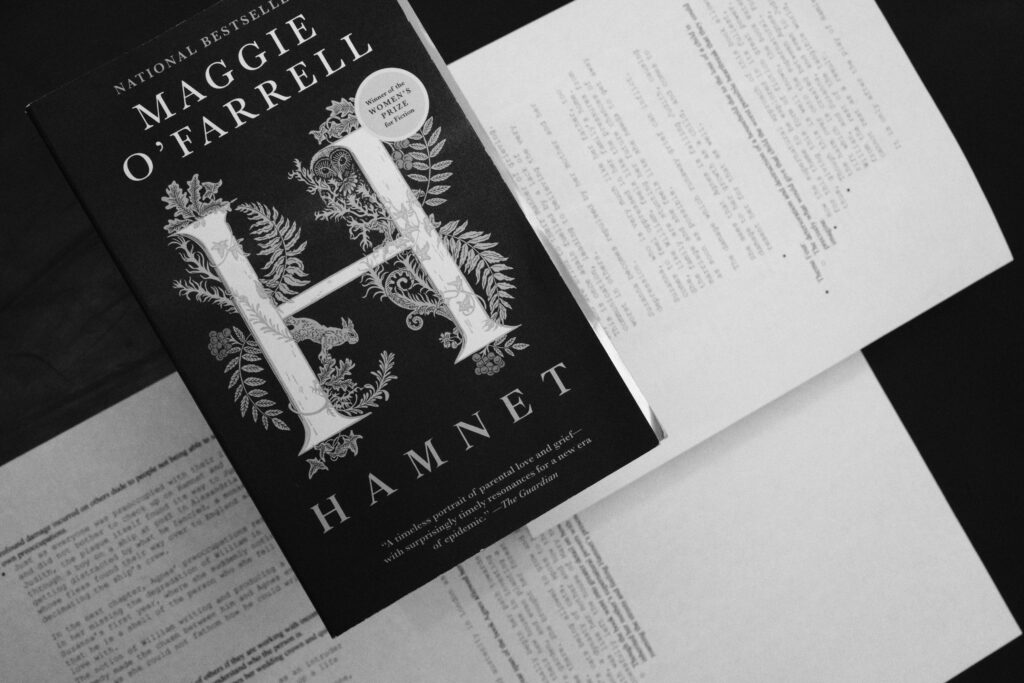
Due to Maggie O’Farrell, the author of the book, working directly on the screenplay of the movie, both presentations of her work stand alone, but are stronger when allowed to support each other. Due to the book’s nonlinear chapter structure and its more detailed treatment of all the characters, it is advisable to watch the movie first before reading the book. Furthermore, the book’s first section, which covers the first two-thirds of the novel, moves at a frantic pace due to its non-linear chapters as it constantly moves from the past to the urgent present. This removes any sense that reading the book after seeing the movie is a chore, while the excellent film’s location, set design, and cinematography act as an accelerant, allowing the reader’s mind to effortlessly place every setting as the author intended. Seeing the movie first will also help those who have not read a book in quite a while, who do not read books or long-form articles frequently, or who have general reading endurance issues.
The book is a title well worthy of your time because of Mrs. O’Farrell’s mastery of pacing and her use of fantastical elements to explore the many themes of this book in a heightened manner. The four themes discussed are relevant to everyone’s lives, and the format of the novel allows for the space to explore them in a complete manner. This is not only impossible on the screen but would have made for an inferior film if attempted.
What makes the movie special and how it elevates the reading experience:
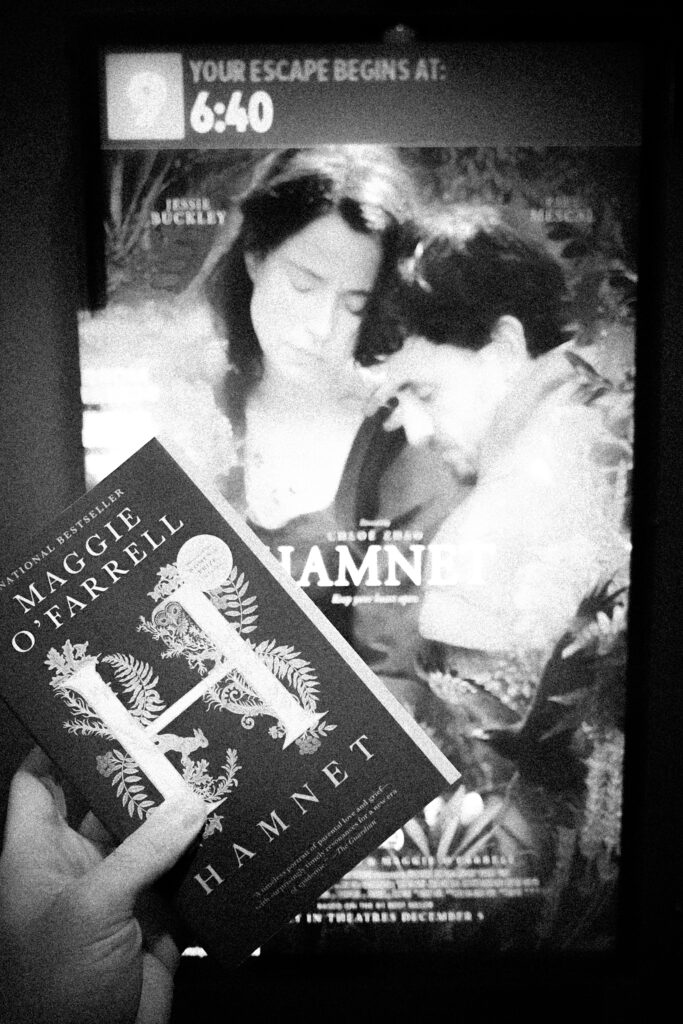
Audiences will immediately point out the difference in the pacing between the book and the film. The book starts out with Hamnet, the son of William Shakespeare and his wife Agnes, frantically searching for help as his twin sister, Judith, falls ill. The movie, however, starts at a meditative pace, similar to a group of yoga students rising from their savasana after a restorative Yin yoga class. The camera pans to the main character of the movie laying at the base of a significant tree , in a fetal position. The use of standard camera lenses with minimal distortion, compression, or overly characterful lens when shot wide open transport the audience directly into the setting. This decision by the director, Chloé Zhao, and the film’s cinematographer, Lukasz Zal, gave them the opportunities to break with the straightforward camera movements in significant moments. The most effective are in two moments where the camera is moving forward across a setting while the character is catching up. Another is the use of a destabilized camera when a severe moment of grief serves as a point of rupture for one of the main characters.
Beyond the brilliant performances from the leading duo of Jessie Buckley and Paul Mescal, Jacobi Jupe gives one of the most powerful performances of any child actor. His portrayal of the brilliant young Hamnet only serves to solidify the reader’s appreciation of the book’s deeper and nuanced look at this character. Lastly, though the book and the movie reach the same ending, they do so in a manner which best suits their own medium, thus making both experiences one that the audience would appreciate.
What makes the book worthy of your time, and how it enriches the movie:
Note: beyond this point, it would be best to have only read the book or seen the movie.
As discussed above, the differences in pacing between the two mediums makes seeing the movie before reading the book a valid option. The book is broken into two parts: the first before Hamnet’s death, and the second after. The second part of the book departs from the breakneck speed of the first, and unlike the movie, which only covered possibly a year or two after Hamnet’s death, it covers over a decade and a half. This allows Mrs. O’Farrell to explore many themes in much greater detail. There are many themes, big and small, in Hamnet, but I have chosen to focus on four, for they are all extremely relevant to our daily lives, and they are all closely interconnected.
The second part of the book breaks with the use of chapters altogether. This disrupts the book’s established rhythm and creates an amorphous passage of time. By doing so, the second part of the book can fully develop the themes we are about to discuss.
The first theme which acts as the book’s starting line is the profound damage incurred on us and others by people not being able to see past their own preoccupations. This is first seen as the adults in the household are too busy set in their own tasks and hobbies, never bothering to simply check in on the youngest members of their family. This leads to Judith going without care for a prolonged and vital period. It should be noted that the Black Plague could kill a patient anywhere from two to eleven days, and it was brought up several times that Judith was immunocompromised. Even how her illness travelled from the Mediterranean was caused by an absent-minded individual who got caught up in their preoccupations, which led to a trail of corpses across the sea on to finally our character’s doorstep.
This directly leads to the second theme, which is that people tend to fill in information gaps with negative attributes, and how a lack of communication serves to rot existing relationships and potentially stop ones from starting on a healthy footing. Whether through negligence or simply choosing to believe the easiest outcomes that support our narratives and preoccupations, this theme appears throughout the book, and with destructive consequences. Mrs. O’Farrell even goes to give an example of how this tendency can be broken when Eliza, Agnes’ sister in-law, is given the opportunity to spend a lot of time with Agnes before their wedding. The detrimental assumptions which Agnes’ family, besides her brother, that of her husband’s family, and that of the greater population are broken down allowing for a healthy relationship to bloom.
The third theme which is closely related to the above is how everyone grieves differently, and how it further breaks down lines of communications. Everyone within the household grieved Hamnet’s death differently, and they tended to look down on others for doing so. Agnes’ grief was utterly crippling, causing her to venture in and out of a fugue state for years, and ultimately failing as a mother to her daughters, who had to pick up her tasks as she grieved in solitude. The weight of Agnes’ grief unfortunately drives those close to her away, from her husband losing himself in his work, to Judith fully immersing herself into nature and the supernatural, and Suzanne, their eldest, taking after her father in handling all of the household’s affairs and like her father, coming to resent her time with the family as one of stunting her future.
Just as Mrs. O’Farrell gave the example of how a little communication can pave the way for better relations, she does this for this theme in the book’s final act. Agnes, finally getting to see how her husband grieved for their son’s death no longer resented him as she saw the play, Hamlet.
All of these three themes lead to the fact that the death of a child will often lead to the demise of a household. Today, this means a divorce and a broken household where children and assets are fought over. As explored in the book, it is in grief’s nature to reside within us long enough to warp reality. This often leads to us blaming ourselves in some manner for what happened. Grief also warps our sense of others and often opens the pathway for us to blame others and to view their form of grieving as an insult to the memory of those who passed. This was certainly on display with Agnes, Willian, Judith, and, to Suzanne’s pragmatic mind, as well. This is perhaps the greatest theme of the book, and one that makes Hamnet essential reading for anyone who loves literature.
The book went into much greater detail about the supernatural aspects of the world, especially with Judith as she would come to stalk the streets of Stratford on late nights as she was entering her adolescence. By venturing into the fantastical, Mrs. O’Farrell drives home the point that the animosity felt by the household resulting from Hamnet’s death would not let Hamnet rest. He was stuck in purgatory until his mother and father finally saw each other for who they were and got out of their own ways. This is a point that is beautifully illustrated in both the book and movie, but the manner in which the book delivers it brings the audience a level of calm and closure. Whereas the movie reaches the same conclusion in a roaring crescendo that is a beautiful and memorable love letter to theatre and the power it yields.
Final Thoughts:
Hamnet by Maggie O’Farrell is a complete book, and coming upon such a title is rare. Mrs. O’Farrell utilizes so many tools at her disposal to bring together a deep and rich tale. Its adaptation into film serves as a great springboard for readers who may have reading endurance issues as well. The terrific casting, cinematography, and setting allow for an easier read. It is no secret that literacy rates are falling in most societies, and I wrote about it here and reading comprehension last year. With only 16% of the American population reading for pleasure, seeing the movie first may be a good option for those who have not practiced their reading muscles in many years. Both the book and the movie of Hamnet deserve to be considered as essential canon. Mrs. O’Farrell explores many vital themes throughout the book, and her depiction of the unique and horrific pain that a mother feels when she loses a child is one that needs to be instilled in everyone. While Shakespeare wrote comedies and tragedies, the ultimate tragedy in this work was of how we fail the most important people in our lives. Our mothers are our most important structural pillars, and when they are in greatest need, we tend to fail them. This is why this book is a must-read, and seeing Jessie Buckley’s adaptation of Agnes on screen is a must-see. We, as children, siblings, spouses, and friends, frequently discount the efforts of the mothers in our lives. This is especially true when they need us the most, for we disregard their heightened pain simply because we cannot relate or understand what they are going through. The greatest power that books and films have is to expand the population’s capacity for empathy. The mothers in our lives suffer so much in solitude and are expected to do so as well. Hopefully, reading and seeing Hamnet will open the eyes and hearts of many when it comes to every mother they cross paths with.