985 words
Time of writing: Tuesday, September 15th, 2026
Makenna Goodman’s title, which has been shortlisted for this year’s Booker Prize, has somehow become a divisive book. After completing the book, I turned to the internet, a rare move on my part, to better understand the book’s final act. Upon trying to find something from the author herself, of which, now a couple of days removed, I am thankful I found nothing, it immediately became obvious that those who complained about this book simply could not keep up with the unconventional structure and prose, and due to the final act, which is confounding. I am thankful that there was no direct explanation given regarding the book’s ending, for there has been great value in coming to rest with the discomfort with the book’s final act and the few interpretations that I have walked away with from it.
Structured in five acts and shifting focus and potentially perspectives between a professor who is in the midst of both his marriage and career painfully ending, a realtor, Helen, the property owner, and one or two more characters, which I will not ruin for you. The acts read like one long monologue or stream of consciousness from each character, occasionally disrupted by another’s presence.
I read this book while in different waiting rooms in medical centres while caregiving for a loved one, and this is why the book proved so powerful for me. Mrs. Goodman’s words resonate when allowed to flow without disruption, for there is an unmistakable forward momentum to how the professor undergoes his journey throughout this book. If the reader puts the book down for a day or two before returning to it, they will lose all sense of the urgency and confused energy which the main character is suffering from.
Mrs. Goodman’s book is an utter triumph, for she not only explores but also lays out the unfortunately common consequences of many marriages and relationships. As someone who has never married, but who has been fortunate to have been in several healthy relationships, this book left me crushed as I sat in various waiting rooms that day.
Mrs. Goodman illustrates how an intimate marriage between a man and a woman can sour one’s view of the world and unfairly cast our negative thoughts from our partner onto their entire gender. The reason why this book left me devastated was that I had seen this happen dozens of times. I had even ended friendships with my male friends simply because of their attitudes towards women as a result of their unhealthy relationship with their wives.
“You wouldn’t understand; you have never been married,” said a friend of mine after I questioned why he was so dismissive of his wife’s career while also being unaware that I had been in a healthy relationship longer than he had been married.
“I’m sorry. I’m not failing to understand you; I am saying that you are an asshole, and you married someone who has, in turn, become an asshole. You haven’t gained a window of insight into humanity simply by being a horrible husband,” I replied.
That was the last time we spoke in private and not within our larger circle of friends. A few years prior to this, I said goodbye to a friend in an elevator after he made a harsh comment towards his wife and her friends when we were on our way down to meet them.
When read in one sitting, Helen of Nowhere will transport you into the shoes of the main character and into the house which he is trying to purchase. You will be thrown into the throes of the history of his marriage and the very complex and at-odds emotions and thoughts that he harbours towards his wife and its consequences.
Helen of Nowhere expands on how marriages which do not allow a couple to grow together and that do not act in each other’s best interests are doomed to fail. In most cases, they lead to a lifetime of misery for those who divorce, which was and still is not an option. In the specific case where the main character and his wife are coworkers, Mrs. Goodman demonstrates how the traditional male mindset of dominance over a wife has simply run its course. I just hope that, as a society, we can reach a point where the exact circumstances presented in this book are not required for a spouse to leave an unhealthy marriage.
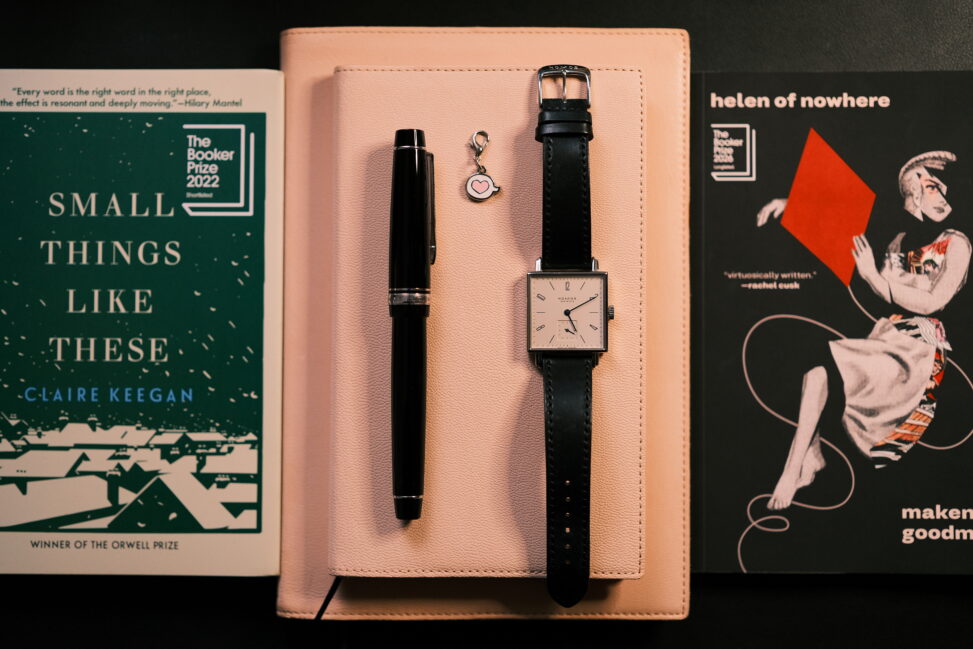
This leads me to the only complaint that I could direct at Helen of Nowhere and many other brilliant works of fiction. In Claire Keegan’s Small Things Like These, the main character’s background of being a father to multiple girls, and whose mother was a single mother who had him out of wedlock, made him perfectly suited to have empathy for a pregnant young woman who was in a dire situation. The one failing of books, even as brilliant as these, is that they overly rely on a person or their situation being perfect for them to have the characteristics needed to overcome a difficult situation. Good humans, at least those I have been fortunate to be around, do not need to walk in another’s shoes to do the right thing, or to be in the exact right scenario to do what is truly best. These circumstances, such as a workplace which supports the position of the main character’s wife, or in Mrs. Keegan’s book, a man who is tailor-made to understand and take action on behalf of another person, do serve to tell the story well, but they undermine how brilliant humans with immaculate hearts are, and how resilient the average person is in real life.
When I closed the covers of Helen of Nowhere, I looked up in the waiting room and saw several older couples. All of them were angry with each other. None of them wanted to be there, and all of the minor annoyances and grudges which they harboured acted as continual triggers as they blamed their significant other for their troubles.
The confusion I felt over the final act, in which the perspectives presented came into question, was overwhelmed with sadness, for I came to the realization that most of the married couples I knew were not only not happy, but full of anger and resentment. I tried to take comfort in the few close friends of mine who were in supportive and beautiful marriages, but the sheer number of derelict marriages surrounding me was simply too overwhelming.
As someone who had never married, and probably never will, Mrs. Goodman’s book provided me with a look into the few times that I could have gotten married. In those cases, I knew that both my potential wife and I would not be happy, either due to their family’s religious beliefs, them being significantly older than I, or careers that drove us into different regions of the planet. Helen of Nowhere showed me what I already knew and have been observing for decades now. Healthy relationships require both parties to not just love each other but fully support their partner for who they are and not let their own preconceived notions of how they fit into the world get in the way. We are living in times when love is not enough, and if one is not willing to get out of their own way to support their partner, why are they together in the first place?
Helen of Nowhere is not just a book to be read by literary nerds looking to be challenged. It is a dense experience written brilliantly about one of the very most relevant and human experiences. At 141 pages, you owe it to yourself to set aside an evening to read Makenna Goodman’s book.
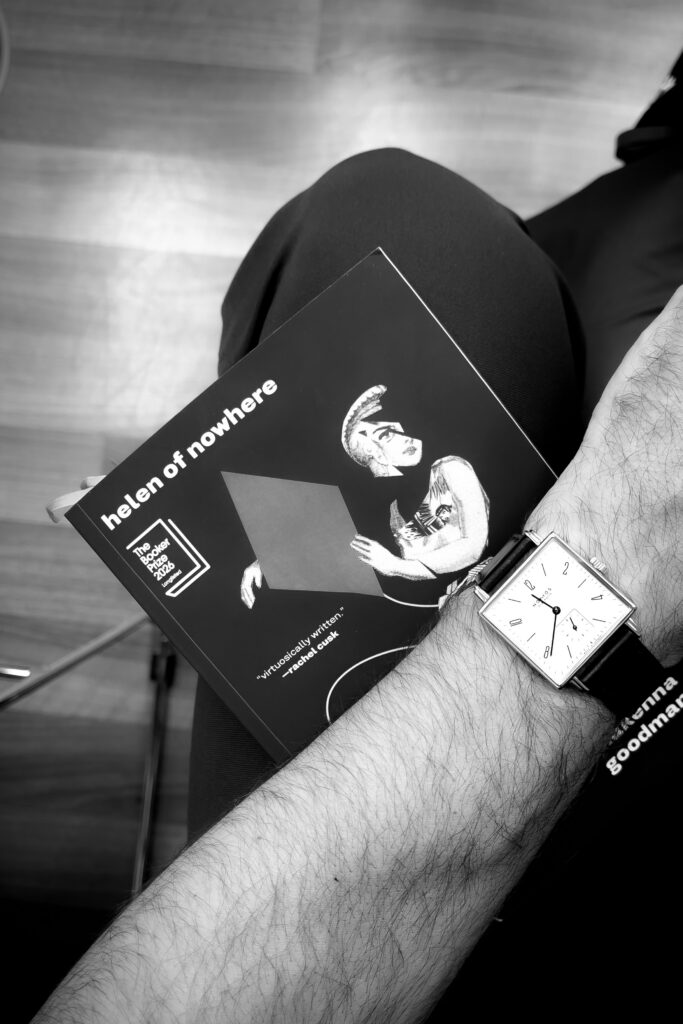
The wondnerfully moving book I was reading while in that waiting room.