1,334 words
Time of writing: Tuesday, October 20th, 2026
My extensive review of Mrs. Murad’s first book, “The Last Girl: My Story of Captivity, and My Fight Against the Islamic State,” can be read here.
No matter how far our species may seem to progress, the darkest aspects of our natures never seem to recede or be addressed. One cannot think of more evil representations of the human race than its never-ending endeavours to abuse and assault each other in the forms of pedophilia, sex trafficking, and slavery.
In 2014, when ISIS took over the Yazidi region of Iraq, Sinjar, all of these acts came to the fore as the Islamic State committed genocide on the Yazidi people. It was not enough for ISIS to erase their culture. ISIS forces and some of the population in Iraq felt the need to enslave and rape Yazidi women of childbearing age and younger. ISIS also felt the need to brainwash Yazidi boys to fight for them. All others who posed a threat, such as men of fighting age or elders who carried with them the history and traditions of their people, were brutally murdered.
Nearly everyone who has heard Nadia Murad speak about her captivity and the horrors that she and other Yazidi women had to endure under ISIS could not help but break down into tears. Mrs. Murad’s background from the poor town of Kocho, as the youngest in her family, and her appearance and cadence of speech made her the perfect spokesperson against ISIS. Her aim, once she was asked to speak, albeit with her words warped by interpreters at the time, was to bring the members of ISIS and those who partook in the acts of murder, rape, slavery and genocide to justice, and to continue finding those in captivity and to unearth their stories. Her goals expanded to rebuilding Sinjar piece by piece, and creating an environment where the Yazidi population could heal and thrive.
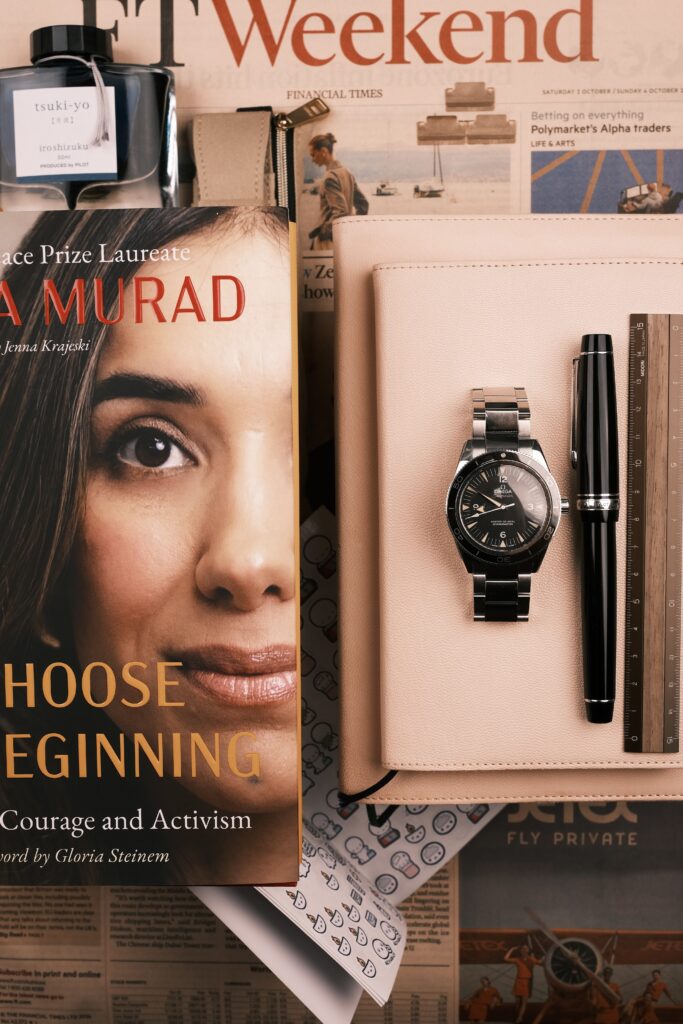
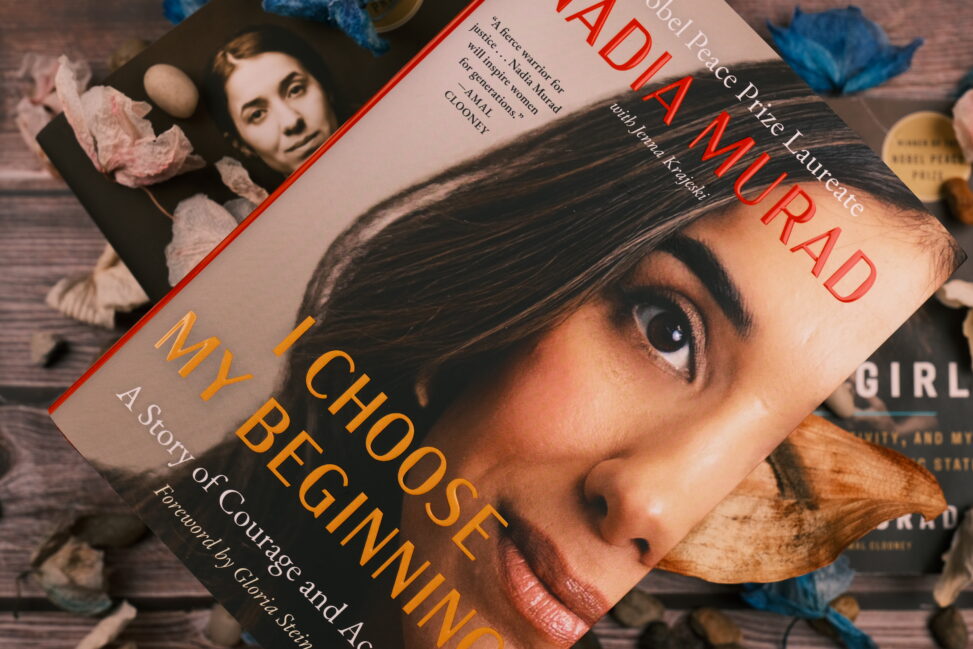
Mrs. Murad’s second book expands on her first, both masterfully co-written with Jenna Krajeski, in which she went over the details of her time in captivity and her eventual escape. While the second book picks up from there and outlines her work as an activist, I Choose My Beginning is incredibly powerful because she describes the Yazidi people, their culture, and the detailed struggles of many others, primarily her family members, as they endured and fought their way through the genocide.
As a result, Mrs. Murad’s book can be an incredibly difficult book to read. This is especially true if you have undergone one or more incidents of sexual violence or are close to people who have. Personally, I felt the air knocked out of my lungs dozens of times before I even read a passage, as I reopened the book. Passages where she details the experiences of her cousins, especially her beloved niece and best friend, Kathrine, can render the reader paralyzed.
This is precisely what makes I Choose My Beginning a book that must be read and not avoided. There are many vital lessons within the pages of this book. First, it lays bare the fact that these atrocities are very much in the nature of our species and require constant defiance. Conflict Related Sexual Violence (CRSV) is still rampant in today’s world, just as sexual violence is outside of conflict zones. The book mentions the horrors of CRSV in Crimea during Russia’s invasion of 2014, but the full-scale invasion brought CRSV to cities such as Bucha only a couple of years ago, illustrating how CRSV is still rampant. Currently, the atrocities occurring in Sudan and across the Sahel are underreported due to the population not having the same level of access to technology to get their stories out. Those who are fortunate to live their lives at a great distance from the world’s atrocities usually hold on to attributes that they identify with as reasons that they could never partake in the abuses and horrors inflicted on others. Here in the G7, we usually like to place education as one of the factors that holds us above others, but in Mrs. Murad’s book we see that doctors too adopted ISIS’s methods and committed gruesome acts of savagery towards the Yazidi population.
In this important work, we also see that many people within society who are educated- often a fallback scapegoat reason used by us in the G7 for our reasoning that someone would not do horrible things- and who are normal civilians, easily gave in to ISIS’s ways of buying women as captives and actively engaging in horrible acts towards them, including the murder of babies.
Mrs. Murad continues this fight for everyone who has been a victim of CRSV, and to rebuild Sinjar, and you can help by donating to Nadia’s Initiative and read more about the genocide and her initiative’s goals here. It should be noted that her initiative has accomplished great work in rebuilding infrastructure, schools, medical centres, and building a new hospital in Sinjar.
Second, the reader learns from Mrs. Murad’s experience how they can better support not only others who have undergone severe trauma, but themselves as well. Having undergone a series of severe, life-altering traumas, every single day and even moment can present different challenges for the affected. Placing expectations on how someone should grieve or manage their trauma, and not meeting them in the very moment, is a disservice to themselves and to those they care about.
Third, much of the book explores the difference between Nadia, the public activist whose name her father registered, and Mardeline, her real name and who she really is. Much of her identity was warped by other activists as they paraded her from one speaking engagement to the next, and much of who she actually was seemed to not matter to mostly everyone outside of her family. In this book, we see how she took back her identity and built a full life for herself.
Once again, we should be grateful for Jenna Krajeski, whose work of journalism has for years covered the Middle East, Africa, foreign policy, and various crises. Her ability to help elevate Mrs. Murad’s voice with her prose really drives every chapter home and makes every page as impactful and as memorable as the ones before. For most, it would be a given to say that we are all indebted to Mrs. Murad for her work; I’d argue that we also owe Mrs. Krajeski a high degree of praise for her work here and elsewhere.
Here we can derive strength in the possibility of being able to rebuild one’s life, to find love, and to refine one’s purpose on one’s own terms. Through the words of Mrs. Murad, we see that there is always more to the story than what we initially assume. And this can have ramifications on multiple levels. Many years ago, after her first speech at the UN, I was not aware of who Mardeline was as a person. Second, everyone whom I had spoken to in North America, mind you, simply assumed that the Yazidi people were a homogeneous group. We, in countries with advanced economies, tend to look at far-off conflict zones, which look vastly different from where we reside, as one-dimensional. In reality, there is not one single culture or ethnic group that is singular in its characteristics, and the Yazidi people are a very diverse group of people who were all targeted by the Islamic State.
The intricate details through which Mrs. Murad guides the reader from her life as an activist, from a survivor to someone who has fought and continues to fight to build a full and healthy life with her husband Abid, make this a book that everyone should read. Having read both of her books, I would recommend reading I Choose My Beginning before taking on The Last Girl. First, readers would get acclimated to the visceral horrors in the first title. Second, the reader will have a much greater appreciation for the beautiful Yazidi people and the immense scale of devastation they endured. If you are going to read one non-fiction book this season, choose Mrs. Murad’s newest work, please.
You can purchase Mrs. Murad’s book here.