
(1438 words)
Probably the only benefit of having to go through the aberration of a year which was 2025 is that the very real extremes that it created can serve as teachable analogies for the more mundane moments of our lives.
In any given society, the experiences of the citizens within it have never been uniform. There are always a few who enjoy a vast amount of wealth and security. There have always been the majority occupying lower-income households, just above the downtrodden. And thanks to industrialization, the middle class emerged, stabilizing the perceived social contract. This assumed contract rested on the notion that if one worked hard enough, they could hope for the opportunity to own property, decent healthcare, and enjoy a fair degree of security from the state to which they paid their taxes. 2025 examined how the confidence we, as a society, had in that social contract degraded during the pandemic, and literally said “hold my beer” as it decimated our confidence in the international rule of law.
Tariffs, ongoing wars, and zero-sum foreign policies driven by profit rather than the agreed-upon values that partners held since the end of the last Great War have widened the K-shaped growth pattern of our societies, thereby pushing more people in the highly valued middle class closer to the lower and downtrodden.
One of the side effects of the well-off doing far better, while the rest of society does far worse, is that a large disconnect occurs between a society’s population. This year, I had the benefit of attending several events where, outside of the staff serving everyone, those in attendance were of the top earners in the area. Heads would nod in acknowledgment among the guests as the topic invariably shifted to the deteriorating state of global affairs, but no examples were provided. I received wide glares when I would bring examples from my own life and those in it. Those wide glares I received at these bougie events were not centred on disbelief at what others were going through, but on a realization that they had lost touch with those around them. The majority of their base interactions were with the middle and lower classes, and a fear of losing relevance was very real among those whom I spoke to, as they immediately recognized the dangers this posed for them and for society at large. Sadly, a fair number of those discussions quickly recirculated, and the topic shifted to outrage over the fact that their $200,000 car did not come with sound-deadening privacy glass as standard.
The economic circumstances that can create a chasm between populations in understanding each other’s struggles are not new and have often split electorates, as in New York State, where Manhattan and its surrounding boroughs remain an outlier. This can also be seen here in Toronto, where the concerns expressed by those in the city’s core only relate to their own immediate issues while they dismiss the concerns of those in the suburbs, and vice versa.
We humans also adhere to other natural things, such as those based on race, and manufacture unnatural differentiators which isolate us and disable our empathy for others. A lot of the time, these synthetic groups are formed by areas in life which capture our fascination. Once they do, before we know it, we spend a disproportionate amount of time and money in the field, and thus an enthusiast is born.
Being an enthusiast is truly a terrific thing, both for the individual and for society at large. Being an enthusiast allows one’s cognitive pathways to remain fully engaged without resorting to a resting state when not working or being productive. A joy many enthusiasts share is meeting other enthusiasts and quickly discovering that they have even more in common, thereby sparking lifelong friendships. The specialized knowledge gained from being an enthusiast can also lead to a new career one is passionate about, thereby increasing one’s overall standard of living.
The downside of becoming an enthusiast in a given area does not have to do with the specialized knowledge that is gained, but how that knowledge can come to be corrupted, like a bad line of code in software. The biggest detriments to any group which is highly centralized around a topic are that a sense of identity arises and brings the group together, and that this sense of identity can decouple the group from the reality on the ground that is experienced by close to 100% of the rest of the population.
One example I would like to highlight is the aversion among enthusiasts to polished surfaces on sports watches.

The scratches on the bracelet of my Seamaster
This always stood out to me as a very odd aspect of watch design for enthusiasts to be passionate about, but recently, I have also come to see writers and journalists mirror these sentiments. This exasperates the echo chamber effect that enthusiasts are vulnerable to falling into; for now, their views are not only being substantiated in forums and chat groups, but in publications. Of course, the issue at hand is that these writers and journalists were enthusiasts in the field long before getting a paycheque from the field.
The first reason why this seemed abnormal to me was how this was contrasted by the views of normal consumers. The major differentiator between what I am calling normal consumers and enthusiasts has to do with how much time they spend obsessing over the field of passion, in this case watches. In most of the cases, the normal consumer owned the same number of watches, and in most cases spent more on each product. Yet, not a single one of them cared about how the polished surfaces of their watches looked more scratched over time.
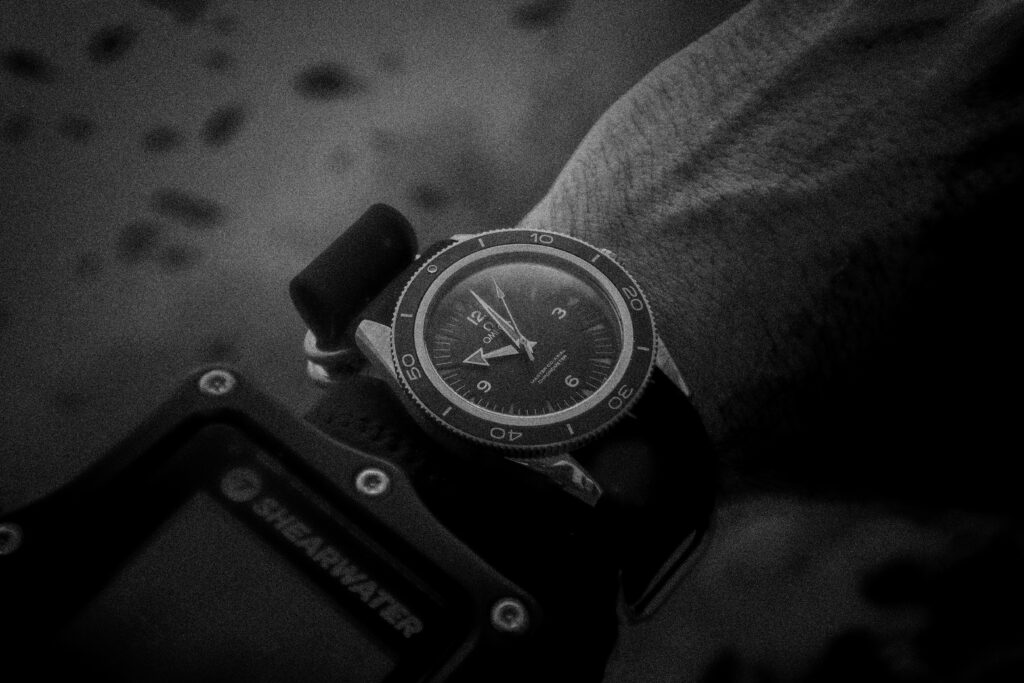
The second reason why this specific topic drew my attention was that I, as a collector, enthusiast, and writer in this field, also have never cared about this. In fact, the watch which I have logged the most dives with, somewhere in the triple digits, is my Omega Seamaster 300 Master Co-Axial. One of the biggest gripes voiced by enthusiasts was their disdain for the polished centre links on the watch’s bracelet. In fact, I have one very good friend who, upon buying his own Seamaster, immediately had the polished links brushed at a jeweller’s.
With over a decade of wear, my Seamaster 300, when compared to other watches in my fleet, pierces through this aversion and points out that there is something bigger at play here. This is the identity aspect of being an enthusiast, warping one’s views and decisions.
First, the scratched surfaces on my Seamaster look terrific. Just like the several Rolex GMT Master II’s, Grand Seiko’s, and Cartier’s I had seen on the wrists of non-enthusiast owners, we did not give a second thought to the scratches on our polished watches. Only a small percentage of those I met even considered getting the watches touched up at its next servicing.
Second, and probably the biggest reason why these humans and I simply do not care about this topic is that at an arm’s length or greater, highly polished surfaces hide scratches better than those on brushed surfaces. The scratches on a brushed surface create greater contrast than those on polished surfaces. For instance, the year-old brushed titanium bracelet on my X33 has fewer scratches and has drawn many comments over the last few months, while those on my Seamaster have not in its decade of service thus far. It is only when looked at closely that all of the scratches are noticed.

The scratches and blemishes on the brushed titanium bracelet on my X33
The issue at hand is that enthusiasts have a belief that their sports watches should look like tools, and not jewelry. They will go on long soliloquies about how a new dive watch release was ruined by an overuse of polished surfaces, and how this is a betrayal of what they believe the watch should represent.
Whenever one feels strongly about any particular topic which does not centre around people not getting hurt, it should signal a specific cognitive process or set of processes being corrupted, like bad lines in a code, not as in corruption in the sense of a corrupt government official.
The downside of having enthusiasts write about fields they are passionate about is that most of them do not take the time to reflect on whether their stance on a range of topics has strayed from reality. Everyone has their preferences, but hard-set beliefs that colour a large swath of any given field usually signal they have strayed from the common human experience and that their opinions are starting to lose relevance.