(1,362 words)
A little over a month ago, on the fourteenth of October, I felt a familiar pang of grief wash over me. Not since the passing of Georgios Kyriacos Panayiotou, who went by the stage name George Michael, had I felt such a degree of loss for an artist until it was time for Michael Eugene Archer, the artist known as D’Angelo, to be taken from us too early. These are two artists who had a great impact on me as a writer, from when I was a professional musician many moons ago, and as a person.
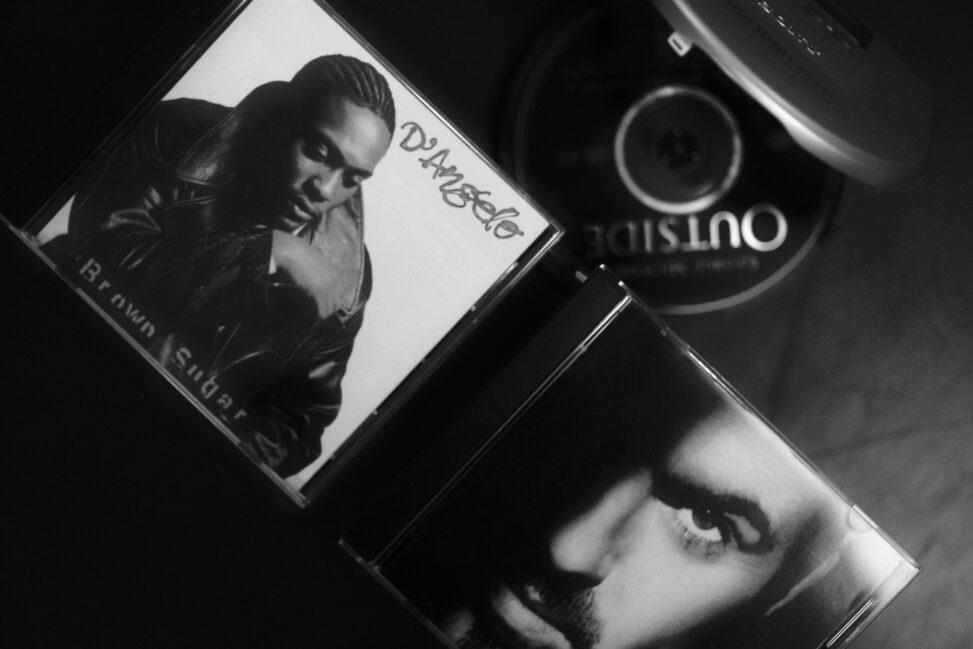
George instilled in me an unusual lesson which I have not seen practiced by many others. His music was brutally honest, especially after his album, Listen without Prejudice. The manner in which the opening song, Praying for Time, opens with a refreshing and uplifting blast of the piano and its accompanying instruments, underscored the unrelenting open-handed and honest approach as one faces the ugliness and heavily unfair world we live in. While most would point to D’Angelo’s Shit, Damn, Motherfucker on his first album, Brown Sugar, as the revealing and honest display by the twenty-one-year-old, there is another song that spoke to the fifteen-year-old me more in 1995. On the B-Side of the album’s cassette, his expansive range shown on Smooth highlighted a respect for playing a sparse role while only interjecting to drive the song’s forward momentum. This mirrored how, as a teenager, I felt when overcome by emotions, and found solace in taking a step back to evaluate why this was so. D’Angelo too broke through with an honesty that spoke deeply to me, and like George, he taught many that being transparent about one’s feelings does not make one vulnerable by default. Sadly, this is a lesson that many of us men still need to heed.
The breadth of George’s capacity to let strangers directly into his soul could not be better illustrated than by his entire album Older. To this day, it is the one album, along with D’Angelo’s Black Messiah, that I listen to from start to end, usually while cooking. While George took us deep into his state of mind and battles with navigating the loss of his partner, Anselmo Feleppa, D’Angelo brought us along as he dealt with the deteriorating treatment of black communities in the states, and those conditions prompted the album’s early release. While Really Love will forever stand as one of the most beautiful and powerful love songs ever composed, 1000 Deaths, The Charade, and Till It’s Done are the songs which still, to this day, make my heart swell and activate my tear ducts.
While both artists had their run-ins with the law, George’s was much more publicized; it was not their imperfections and capacity to fall which created the mystique that came to surround them. The television show Atlanta tried to capture how ethereal a figure D’Angelo was in the episode titled Born 2 Die. As the lead character tried his best to sign D’Angelo as an artist, he was forced to undergo a mind-bending, near-dimensional-drifting journey only to fall short. George did not have the luxury of fully fading into the background due to his level of stardom, though he tried.
What truly made both of these artists special and what makes their work resonate with an uncommon purity is that they refused to be exploited. Both were uncomfortable with being placed on the mantle of being made into sex symbols, for their own reasons. While some would argue that this led to less productive careers, if they had their way, they might have produced even less, but that makes what they released all the more special, for as we were fortunate to enjoy their undistilled work. Commercial artists who reach the level of success these two have are usually contractually forced to produce albums at a high frequency. When one does not need new avenues of income from new work, being forced to work and create art one does not believe in will result in work they deem subpar. D’Angelo and George, unfortunately, due to being taken from us so early, did not get the opportunity to add to their contributions to society, and millions of hearts ache at this fact. We miss them dearly. Each of their songs has branded their essence on our souls, unlike many other artists and their constant, ultimately forgettable releases, which fail to do so as the years pass.
Brown Sugar was released in 1995, and Older the following year. Both albums stayed in my Walkman for years during commutes and while doing chores. Thirty years later, in my forties, the closest form of repetitive media consumption I partake in is the daily routine of reading several newspapers and magazines, with the same staff writers appearing anywhere from two to ten times per week. Those who cover the news in a specific region become welcome voices to be relied upon. Those who write opinion pieces, however, run the risk of overstaying their welcome on my reading list. Like recording artists, writers are under pressure to write a set number of articles a month, and at times, you can tell that they are just trying to meet their quota. This is usually spotted when the opinion or insight they offer either sums up basic common sense or has essentially been a summary of the work of others writing for the same paper.
Writers and musicians are not the only ones who can overstay their welcome by producing too much. We mere normal mortals working mundane jobs that will never be remembered are placed under the same professional and, oddly, social pressures. Many of us are cursed with a coworker who cannot stop speaking up at meetings, a family member who always provides useless feedback, and a friend in a group chat who chimes in at every opportunity. We humans rarely bat a thousand when it comes to bringing genuine worth to every appearance, and this also goes for the most brilliant of us.
The reason why so many of us miss these two artists more than most others after they pass was not that they lived short lives that burned unsustainably bright; we miss them because they gave us masterpieces selectively. They didn’t waste our time or betray our earned trust with work that was not worth exploring or incorporating into our lives.
We, too, can learn from this and only contribute when we know for certain it has a chance to make a positive impact. Over the last half-decade, I have come to observe hundreds of families and how they treat their parents and grandparents as they enter their twilight years. With some exceptions, of course, the one character trait shared by those who are frequently visited by their loved ones is that they listen far more than they talk. When do speak, usually in a soft voice requiring their loved ones to lean in, every word is soaked in.
Most of us, whether we would like to admit it or not, would like to be remembered fondly. More obviously, we would not only like to not be lonely, but to be surrounded by the people we love and respect the most. What D’Angelo and George Michael have taught me is to always focus on the worth I bring to a room. Do I bring insights which are relied upon? Am I a source of comfort and security? Or am I here to fill a vacant seat and to provide a laugh or two as the evening progresses? We can all do a little better by focusing on genuinely making the lives of those around us better by deploying the same methodical filter that these two artists did throughout their careers. If D’Angelo painstakingly perfected and slaved over Really Love over 20 years, we can sit on the feedback we are about to provide to a coworker or relative, which will ultimately fall upon their deaf ears. Doing so will ensure that the gradual vignetting of the final chapter of our lives will not be spent alone and afraid as we sail off into the darkness.

Time of writing: November 27th, 2025