1,286 words
Time of writing, June 5th, 2026
A common shorthand for quickly sizing up another person is to observe how they conduct themselves under unexpected pressure. It is at this point that one’s public-facing self melts away as they struggle to get a firm grasp on how to proceed with minimal damage. Whether trying to ascertain another person for an employment position or a serious relationship, this is also where extroverts who genuinely love humans can find a great deal of gratification in helping others while also learning as much about them as possible in a single interaction. It is in these moments that we learn the most about the other person, their background, their frailties, strengths, and everything that makes them the beautiful individual that they are.
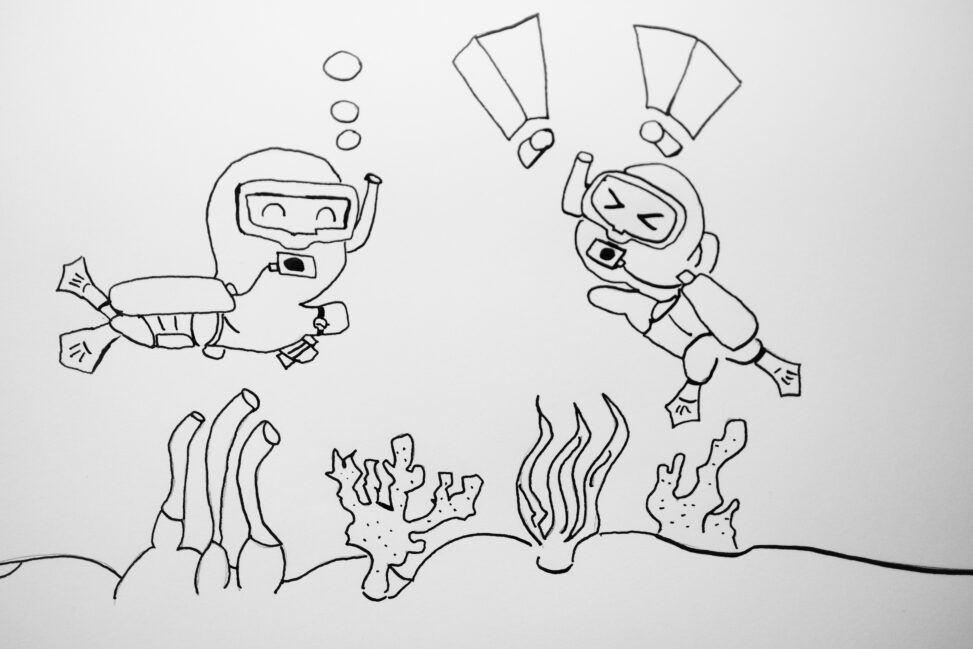
It is unfortunate that the sport of scuba diving is marketed by the field’s professional agencies and operations as a tourist experience rather than a serious sport. Diving, unlike most sports, immerses us land mammals in the very alien world of our planet’s depths. We have not evolved to exist in such environments. Apart from ancient cultures such as the Ama freedivers of the Okinawan region of Japan, who had for centuries undertaken the extended breath-holding form of diving for fish and then later pearls, every fibre of our bodies is wired to avoid being underwater for any longer than a couple of seconds. Now, the sport of freediving has flourished. Drowning is one of our most common and innate fears, yet hundreds of thousands of people across all age groups, backgrounds, and levels of physical fitness sign up for their beginner open-water scuba diving certifications every year.
In my years of dive instructing and volunteering, I have come across many who either had a known or an unexpected fear of diving, and those who found out in real time that they were in over their heads. Due to the frequency of encountering students who have had a near-drowning experience unearthed during the introductory pool session, I have sadly come to expect this every other weekend. I am fortunate to have worked and continue to work with dive shops whose first instinct is to send over these students, along with those who have trouble equalizing1 over to me. It is usually at this point that we start a private session with the goal of diagnosing and hopefully solving their issue.
My tendency to help other divers began long before I even set out on my path towards becoming a professional in the field. When I was doing my own beginner’s open water certification, the instructor paired me up with another student who had shown signs of needing an extra hand. They were completing the certification for an academic course requirement abroad, and they had no genuine interest or capacity for putting in the work to be an active and safe participant in the water. Over the course of those two weekends, the instructor watched me as I retaught my dive partner the entire course and eased them into successfully completing their certification. Later that year, while completing my advanced open water certification with another dive school, the instructors immediately tasked me with taking up the rear of the students, thereby herding them, and controlling their safety stops as they took on other tasks with the second grouping of students. All the while, for years, the various local dive shops pleaded with me to work with them as a professional, but life had other plans; I simply did not have the time.
It was not until many years later that I began my journey as a professional in the field that the shops immediately placed students in need of extra attention and care under my care. It was then that I fell in love with teaching diving, for unlike teaching music2, the addition facet of the life-and-death stakes of the sport repeatedly brought out the best and worst of others to the forefront.
When the stakes are elevated past one’s normal threshold, a lot comes to the surface. This makes being an attentive dive instructor possibly one of the most gratifying jobs for someone who genuinely loves people and everything that makes them operate in the distinctly unique ways that only they do. This also includes people who conduct themselves in manners that would be best described as distasteful, for there is always a long tale of how that individual for to where they are in life3. For those who live for and love being in the service of others, being a dive instructor offers the opportunity to take on a truly polyvalent, constructive, and transformative role in the lives of others. The difficulties that we are able to resolve in the water have profound implications and applications for every aspect of their lives in which their anxiety can play a detrimental role.
In helping those get a handle, diagnose, and to give them the tools to overcome their fears, or to help them build awareness in their body transcends into every aspect of their lives. Demonstrating how one’s bodily systems, such as one’s lungs, diaphragm, sinuses, and muscles along their pectorals, neck and back can all be made to work together gives laypeople the cognitive tools necessary to recognize that something is wrong. They are then empowered to work towards a solution, whereas before they would be content to live with the discomfort and pain.
Nowhere else have I seen a better environment to see a person’s capacity for handling anxiety and task loading than in the water when they don on scuba gear for the first few times. Traumas, related to the water or not, pathologies, chronic injuries and stress factors from their daily lives all come to the surface when the first unexpected thing happens when they are underwater4. People easily get overwhelmed, their vision narrows, and they lose track of the class, fall behind, and start to spiral as they feel like a failure.
This is supposed to be a cute thing that tourists do, right?
I wasted an entire two weekends and nearly a thousand dollars on this?
Great, is this just another way that I am holding back my friends and family from our plans?
Oh god, why am I breathing so hard?
I would do anything to get away from this feeling and just go home until Monday morning.
Having such thoughts cascade through one’s mind is unfortunately not an uncommon occurrence, and in helping the individuals come to grasp with their perceived challenges reveals a lot. Beyond the aforementioned water-related traumas, stressors from their normal lives, or the pressure that they may be under to complete the certification, it is often brought to light that the person in question has no tactics or coping mechanisms for dealing with stress other than hoping that it would go away.
The look on a student’s face when they are brought to a physical and mental place where they are once again capable of relaxing and giving them the tool to do so has been the most impactful gift and tool I have taught others.
Feedback after the fact revealed that the same tactics deployed in handling their stress and fears in the water directly helped them become calmer while driving, at work, and when dealing with a difficult family member. Empowering them to not have to give into being a passive participant in their life when it gets difficult is the reason why I have fallen in love with the field of diving. This is the reason why I do not regret not having gone on a fun dive in over six years, and to have devoted all of my time underwater to the service of others.
- The process of equalization is, through various techniques, making various air pockets in one’s body, usually in one’s sinuses, to equalize with the current pressure the body is under.
This is typically the area which most people have difficulties with, and even professional divers may have trouble equalizing at the start of a dive season if they were inactive for a number of months.
Failing to equalize can result in very serious injuries that can range from needing bed rest to requiring surgery. - I have a background in music and have taught music privately for a number of years.
- There have been several instances where I have been tasked with a student in a class setting, or a diver in a recreational dive setting abroad, where they were not capable of diving and were a danger to others. This subset of people lied about their capabilities in various aspects of their lives.
The joy in teaching these individuals is unlocking the puzzle of who they actually are, and in many cases, getting them to drop their act, whereby they actually confide in you and genuinely ask for help.
- This is usually a trickle of water entering their mask and either making contact with their eyes or nose