1,550 words
Time of writing: Monday, September 14th, 2026
Notes: As part of the NOMOS Tetra Suite, this is the first recollection from a series of incidents I gained a more personal connection with the watch. Suites on this site usually include a short-form review of the timepiece, a long-form review, and at least one real-life incident like the one below. You can find the entire Suite for the Tetra here.
Parts of this piece attempt to translate a language I am not fluent in, and I offer the best possible interpretation. A (?) follows the words I struggled to understand, but using the context of what was said, I wrote what I thought best represented what was spoken to me.
The waiting room had a presence that could be best described as empty. Though one could hear people talk over their phones, speak to the receptionist as they explained why they could not wait any longer for their appointment, all while combating the street-level noise bleeding in opportunistically whenever another ailing soul entered, the room itself simply lay in silence. Not a hum was emitted from the ventilation system. Every keyboard stroke from the receptionists failed to find an echo in response to their calls. Rooms like these, where the sound of one’s breath becomes deafening, cause unease, and never one of a joint sense of community. Everyone is there out of self-interest. Only hoping to leave as soon as possible.
This space had the air of a mismanaged and understaffed purgatory. Remnants of the pandemic stood their ground as opaque plastic dividers between the seats that once were clear, unscratched, and unscathed. One of many waiting rooms on a ground floor facing a major street, this medical imaging office offered no one any semblance of rest. Temperatures fluctuated as the shoulder season’s awkward daytime heat wave found its way in whenever someone used the automated doors. Arguments in at least eleven different languages; within several dialects within, polluted the air as multiple groups argued over the convoluted paid parking situation at the dated pay station.
Seated directly across from me were two women on opposing ends of the spectrum of existence. It was like watching one, an indoor cat, recoil in disgust at her first encounter with the other, an outdoor cat, far from the confines of her home. The lack of refinement, consideration and civility enraged her as she looked on.
The indoor human glared at the woman seated beside her with utter disgust. She, uncomfortable as she was in public, was glaring at her temporary neighbour as she took out an egg salad sandwich easily dwarfing either of their heads before starting to devour it, mercilessly. Miraculously, not a single crumb was lost as she expertly made short work of her sandwich, which could have easily been misidentified as a small dog by someone who had forgotten their glasses at home. Nevertheless, the indoor human started looking for allies to share her revulsion in the outdoor human, and there were no takers. Everyone’s warped and asymmetric expressions were lost in their phones.
Save for me. Having already made my way through two-thirds of one of this year’s books to be longlisted for the Booker Prize, the person in my care was stuck in a backlog, unseen in a hallway where they had been called ten minutes ago. Apparently, this office used hand-me-down equipment in which those with mobility issues often either got stuck in or helplessly would become a part of the claustrophobic equipment. Limbs contorted as the patient made it worse by not listening to the technician.
Before I got the chance to dive back into my book, it was my turn to be an indoor cat gawking at a feral feline as they stumbled in. Standing at a five-foot-ten bent frame, wearing a heavy Halloween-themed pyjama onesie, was a grown man in his late forties. Eyes permanently glazed, and his neck was lined with ingrown hairs from years of last-minute shavings, his pink Crocs did little to hide the fact that the underside of his feet had never been touched by another human.
Trailing behind him was his mother. From her headscarf to her orthopedic shoes, this elegantly dressed octogenarian in monochrome shades slowly made her way into the waiting room, resting almost all her weight on her cane. Her son just stood there, almost blocking her way in, before deciding to move so she could find a seat. After her laboured landing procedure, she gently turned her head upwards and in a dialect of Afghani, she asked her son to go to and check her in.
“Yeah, you’re going to have to do that on your own,” he replied in English.
“Sweetheart,” she said, hiding her decades of disappointment behind her beautiful pale eyes whose shade resided somewhere between hazel and that of a paper maple tree’s bark in the autumn.
“I’m going out for a better connection,” said her son before she could continue, as he put his phone back into his black-and-yellow furry pyjamas that were damp with sweat. With that, he stormed out even before his mother could finish her exhalation.
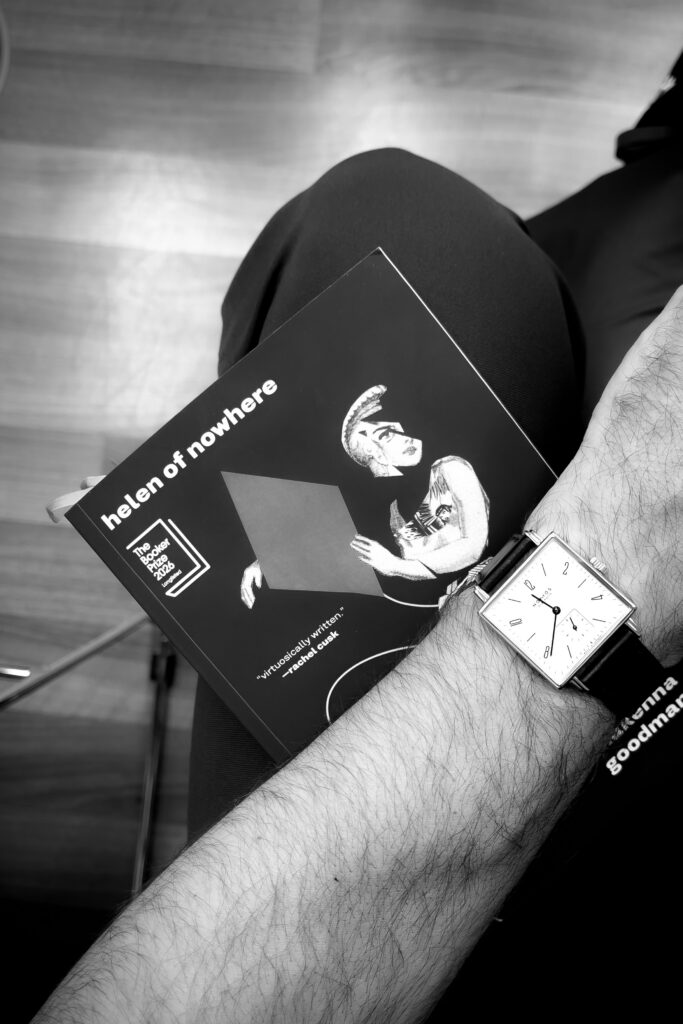
The wonderfully moving book I was reading while in that waiting room.
I put my book away and quietly made my way over to her. Though I did not speak her language, I understood enough to ask her questions in English so that she could reply in her mother tongue.
“Hi, I can check you in if you would like,” I asked in English, “and don’t worry, I think I can understand most of what you’re saying.”
My smile was outmatched by hers as she stretched out her shaking hand and introduced herself with a startlingly firm handshake. “My name is Sawhar, and here is my Health Card,” she said as her other hand fished it out of her open purse. “How long will you be gone?”
I turned and looked at the lineup, which consisted of four other patients, all using walking aids. “I’ll be back in about ten minutes, I hope.”
Her eyes gave a brief glimpse of defeat, as she visibly did not want to be alone for that long. She was about to give a stranger her health card and possibly her only piece of ID. This stranger, me, not only towered over her son but also had a voice deeper than every demon from her childhood nightmares back home. In her eyes, I saw the many times in which men like me took her for granted and possibly just took advantage of her. I saw in her eyes, ever so briefly, the doubt in her choice in trusting me with her health card.
My brain desperately reached for a solution. My heart broke. Over the last half-decade, I had come to know many like her, but who were in much worse condition. As my mind strategized a way to settle her hers, my heart reached for my left wrist. Seeing that she did not have a phone or a watch, I took off my wristwatch and handed it to her.
“This way you know I’ll be back, and you can keep track of how long I’ve gone.”
An unmistakable expression of relief instantly took over her face as she eased into the uncomfortable plastic chair that creaked, fighting back every single one of her frail hundred pounds. She held my watch in her right hand and squinted her beautiful eyes to make out the time. Her smile softened, yet cemented.
When I returned to her and handed her health card back to her, she gave me a warm smile and said thank you in her lyrical language, along with a string of sentences of which I made out about forty percent.
“I keep telling my daughter that these tests are unnecessary. It is as if she is trying to right the wrongs of only getting back in touch when she needed me as a grandmother.”
“How old are your grandkids?”
“There’s the one. He’s five. He’s a terror. I’m used to people in my family being indifferent. This,” she said taking a pause to start tapping her cane firmly on the grimy tiled floor.
Tap, tap, tap.
Tap.
Tap.
“This, is different.”
“What do you mean,” I asked now realizing that there were two other women staring at us who were from a country neighbouring Afghanistan in the waiting room, staring at us. It dawned on me at that moment that they were far better equipped to help this woman as her son abandoned her.
“He scares me. He stares at nothing and violently attacks things (?) when he thinks no one is looking. Why couldn’t my daughter have had a son like her benign (?) brother?”
The break in our conversation was broken by the two woman staring and smiling at us, and offered the elderly woman the chance to return my watch, long after I had given her health card back. The battle between the indoor and outdoor cats had long come to a halt, and now these two women with their dyed blonde hair, prominent make up, and khaki -hemed outfits were seated across from us. Their predatory smiles lingered, as they made no attempt to hide their interest in me and the elderly woman.
“What do you make of them,” she asked quietly leaning towards me, presenting a waft of turmeric and other unidentifiable spices from her headscarf.
“To be honest, I am too tired to make anything of them and why they are looking over here and smiling. Anything beyond simple civility sounds too exhausting…” I was cut off by my relative coming out of the procedure area, looking slightly dazed as their eyes looked at the empty seat I was originally seated in with confusion.
“It was nice meeting you, but I got to go. I wish you the best, Madame.”
“Bless you.”
I quickly put on my watch, missing its usual strap minder hole, reached for my backpack, and wore the watch too tightly for the remainder of the day.